

Money
There are a lot of factors to consider when choosing a ball, and the price is one of the most obvious. You can pay anything from $0.50 to $4+ for a golf ball. While some of you may not be concerned with price, it may be a deciding factor for others.
If you do feel that your choices are limited by price, I would suggest looking into used golf balls. There are a plethora of sites that sell high-quality used golf balls for a fraction of the new price. I would also recommend looking for deals on older models. While there are improvements from year to year, they are typically modest. There’s also an expanding market of companies making premium balls for prices well below those of the big names.
The Technical Stuff
When it comes to golf ball technology, there are 2, possibly 3, things that really matter.
The Cover – When it comes to the cover, there’s urethane and there’s everything else. Every $40+ tour ball has a urethane cover because that’s what delivers the most spin on wedge shots. The downside of urethane is that it’s not as durable as cover materials like surlyn. However, durability is less of a concern as manufacturers learn to make more durable urethane covers and wedges no longer have the ball-destroying grooves of yesteryear.
The Layers – From cover to mantle to core, golf balls are made of multiple layers. Inexpensive distance balls are generally made of just two pieces. On the other end of the spectrum, tour-level golf balls have anywhere from three to five layers. These extra layers give the engineers more flexibility to use different materials and more finely tune the ball’s performance.
Compression – Compression used to be a major part of golf ball buying (and marketing), then it almost disappeared, and now it’s making a comeback. The compression used to be a measure of manliness – playing a high compression ball meant you were a stud. Now there are Tour-level balls with low compression because the emphasis has shifted to “low compression feels good.”
Different Golf Ball Fitting Methods
Just as there are many different golf ball manufacturers, there are many different theories about the best way to fit a golf ball. Let’s take a quick look at three of the best-known.
Distance is King/Fit for Swing Speed – The Bridgestone Method
What does every golfer want? More distance! So let’s pick the ball you can hit the farthest.
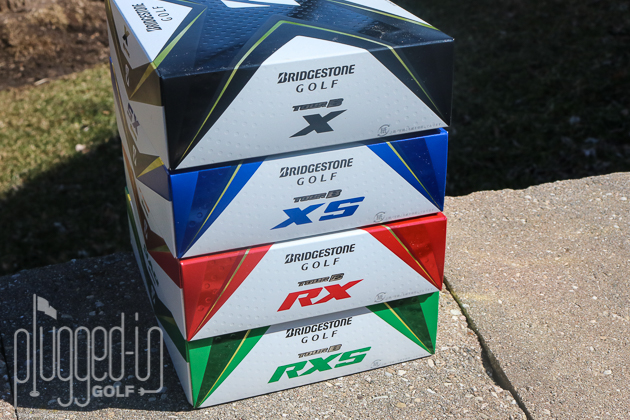
Of course, that’s a slight oversimplification, but that’s what Bridgestone’s ball fitting is primarily about: distance. Their Tour B family is explicitly divided into swing speeds of “Above 105 MPH” and “Below 105 MPH” to help golfers choose.
From Green to Tee/Everyone Needs a Tour Ball – The Titleist Method
If you’ve watched more than a minute of golf or picked up any golf magazine, you’ve seen Titleist’s ads stating that every golfer should play the ProV1 or ProV1x. Their logic seems airtight: most shots are taken within 100 yards of the green, and tour balls perform best in that area.
In truth, the Titleist fitting process is a little more involved than simply, “Buy a ProV1.” They advocate starting on and around the green and finding the ball that performs best for you in those areas. Only if you are pleased with the short game performance of multiple different models should you use distance to decide.
Tour Balls for Tour Players – The Srixon Method
This last one isn’t so much a fitting method as a different perspective on the idea of amateurs playing tour balls. In past ads, Srixon has claimed that tour balls, which spin more, will exacerbate the average player’s tendency to slice and hook the ball. Bridgestone has picked up on this idea in the marketing of their e-Series golf balls. They promote a lower spinning ball as a better option for recreational players.
The Plugged-In Golf Method
I don’t necessarily support or oppose any of these methods. Ultimately, it comes back to why you play the game. If you play purely to have fun and to out-drive your buddies, then you should buy the longest ball. If you want to shoot the lowest scores, find the ball that will help you do that. In the end, these fitting models are simply frameworks that will help you to make a decision, but none of them can fit every player perfectly.