

3 Golf Swing Tips That Actually Help Your Golf Swing
If you ever wanted some simple golf swing tips to help improve your golf game, look no further. These 3 simple golf swing tips help you work on 3 different aspects of your swing.
Have you hit a plateau in your golf game? You’re hitting the driving range and golf course every weekend, maybe even practicing at home, but your scores never change.
Even if you don’t care much about besting your buddies, we all want to best ourselves. We want to see clear improvement and know that our hard work is paying off. If you’re stuck in a rut, it’s not because you’ve reached your full potential. More likely, there’s some small error in your golf swing that’s holding you back.
I’m going to share three golf swing basics that are proven to help you play better golf. I’ve used these tips with my students for over twenty years, and the results have been transformative.
These concepts cover three different stages of your swing:
- Takeaway
- Transition
- Finish
You may not need all three golf swing tips, but odds are at least one of these tips will illuminate an error you didn’t realize you were making.
What is a Good Golf Swing?
If you are really looking to improve your golf swing, you should probably start with the basics. If you are struggling with your golf grip or setup, your swing is probably in trouble before you even swing a golf club.
Get a (Good) Grip
For starters, get the club in the fingers instead of the palms, and make sure you keep a short thumb on that lead hand (left thumb for a right-handed golfer). Gripping the club in the palms and extending your thumb are both common mistakes, but are very simple fixes.
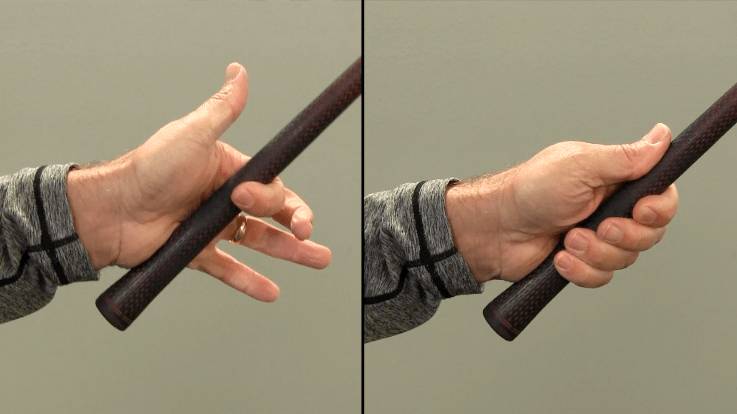
To test your , take the and hold it out in front of you with just the lead hand, using only your index finger. If you are able to hold the club with your index finger and the pad of your hand, you have a good . You will also notice you can perform while holding the club like this, another good indicator of proper .
Setup
Next, let’s move into the setup. An athletic golf stance is key, meaning a nice stable base and a little knee bend. You should not be locking your legs, nor would you squat into your stance. Just being in a ready, athletic posture, feeling nice and natural over the ball at address.
Make sure you get more pressure in the lead foot in your initial setup. We like to promote a 60/40 split, but you can move that up or down as needed. A good place to start would be to bump your hips slightly forward in your setup, so that your lead hip is directly over your lead foot. Stance width should be about shoulder width apart, depending on the club you use. (Learn about the difference between driver vs iron swing here)
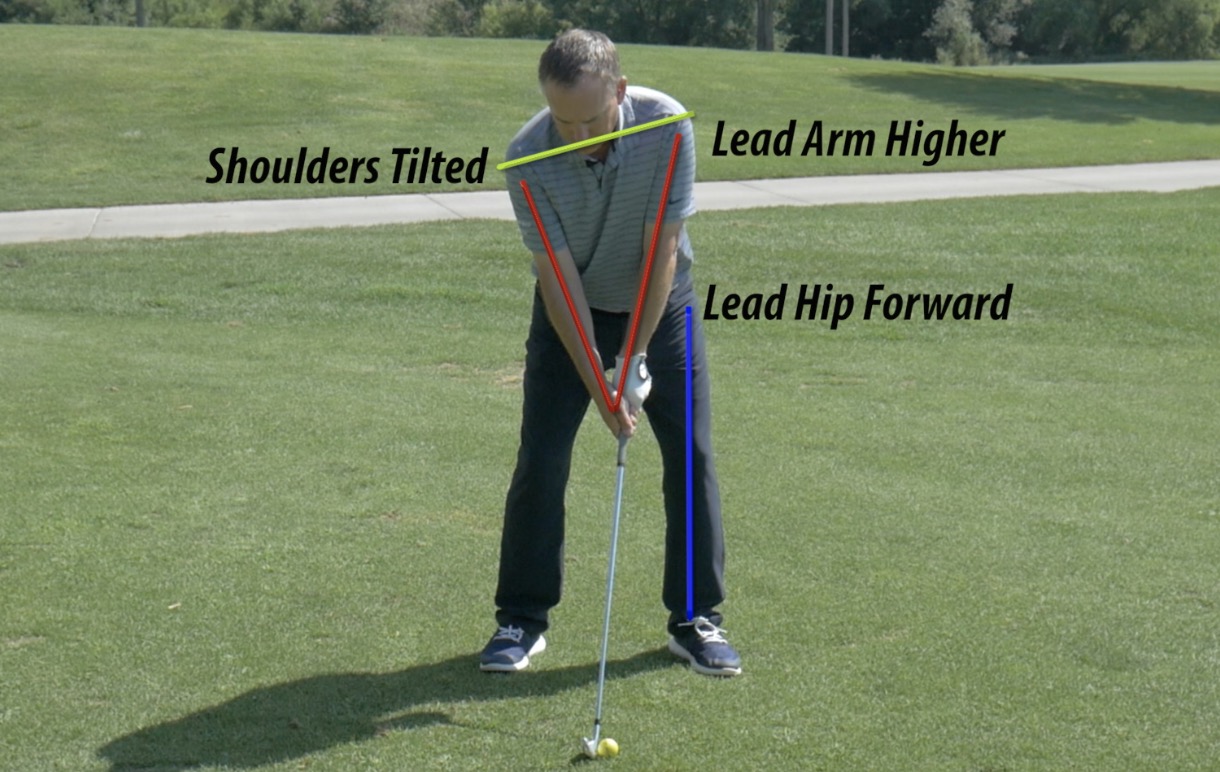
Finally, raise your lead arm (left arm for a right handed golfer, opposite for lefty) slightly above your trail arm, which should move your shoulders a little as well. Your trail shoulder will be slightly lower than the lead shoulder, shaping the ball flight into a nice high draw. This helps move the club path up and to the right, which helps the ball turn over and draw. With practice it becomes easier, and it feels more natural.
Now that we have a good grip, a proper setup and an athletic stance, we can get ready to cover the swing. In fact, you could even teach a golf lesson to most of my students just knowing this information. But now that your grip and setup are in a better place, let’s discuss what is happening in your swing.
What Causes a Slice in the Golf Swing?
This is a good question, a common question, but a complex one. Unfortunately, there are several different things you could be doing in your golf swing mechanics to slice the golf ball. It could be as simple as ball position, or as complex as understanding gear effect. Fortunately, it all boils down to 2 factors: the relationship between the club face and the swing path.
When there is a difference between face and path, that difference is what creates curve. Below, you will see 2 driver swings that both result in a slice. One is a slice based on path, one is based on club face.
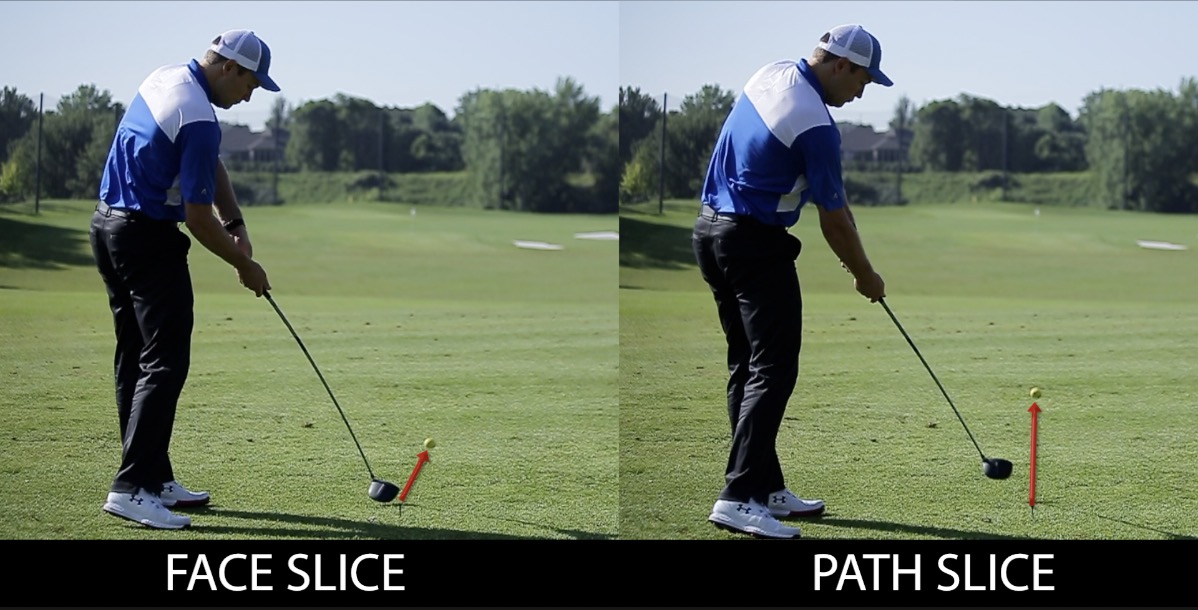
Now, if you are slicing your driver in particular, this is a good visual. Let’s start with right after impact.
In the face slice, the club is wide open, causing the ball to start immediately to the right of the target. In the path slice, it is not immediately known whether or not that ball will slice, hook or go straight. That is the first part of the equation when diagnosing a slice: Where does the ball start?
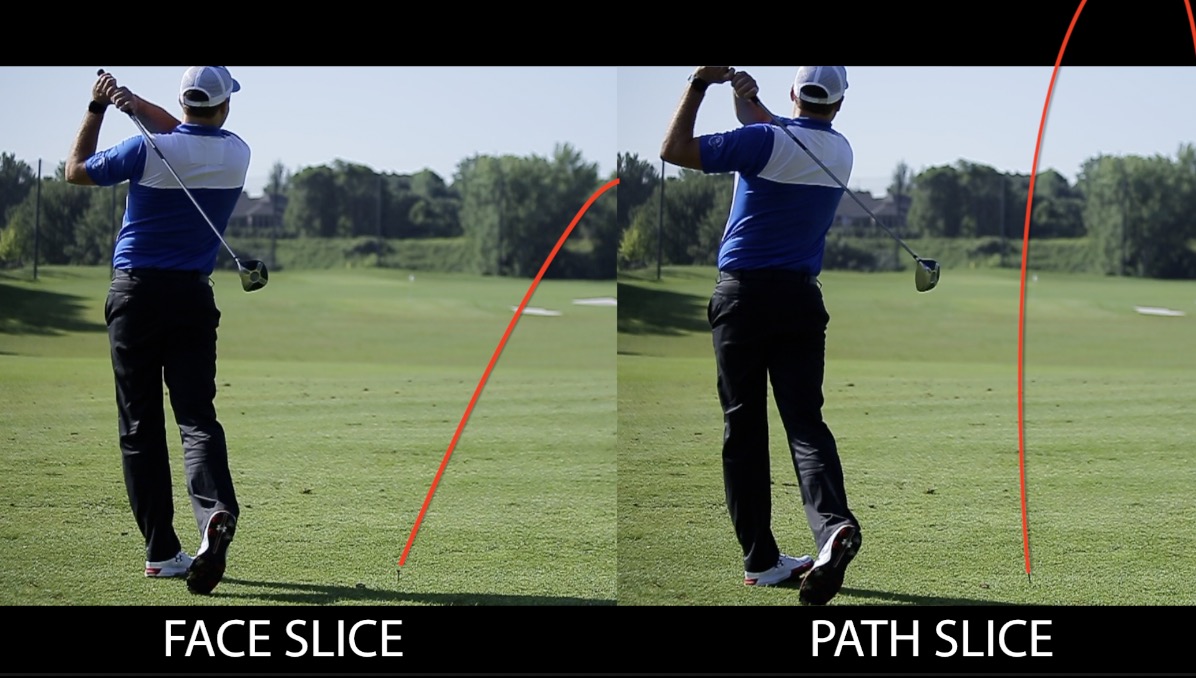
Let’s take it all the way through the golf shot. Now, the first ball obviously started right and continued right. That is a face issue. The second ball starts straight, but then bends off to the right of the target. So if it starts straight, the face was on line, but there is a difference in path creating that resulting curve. This is the second part of diagnosis: Where does the ball curve?
So if the ball starts off line, you have a face issue. If it starts on line, then veers off, you have a path issue. When in doubt, remember this phrase: The face sends it, the path bends it.
Golf Swing Plane
Now that we have talked about the face of the club and the path the club travels on, we should identify a common error in diagnosing an in to out path vs an out to in path. The issue stems from the confusion that swing plane is the same as swing direction. This, however, is not true. Believe it or not, a golfer can have an in to out angled swing plane yet still have a club path at impact that is out to in.
The swing plane is the angle in which the club works up in the backswing and then back down in the downswing. If your angle of attack is exactly zero, the swing plane will be going in the same direction as your swing direction. The issue here is to hit a solid iron shot we hit down into the golf ball. A negative attack angle shifts our swing path to the right (vise versa with a positive attack angle). This shift only occurs with the swing path creating a vast difference between the swing plane and the swing path in our golf swings!
What is the ideal swing plane though? The swing plane changes with a lot of different variables and can be quite different from golfer to golfer. The ideal plane matches the angle that the club shaft makes at setup. Taller players may have a steeper swing path or those who stand a little closer to the golf ball. A steep swing path that comes to mind is Justin Thomas’s golf swing. For an exact comparison, check out Rickie Fowler’s golf swing. He tends to be a bit lower in the setup creating a flatter swing plane.
Remember, the swing plane and swing direction are different measurements. If you are looking at your golf swing on video you are watching the swing plane. A solid swing plane is important to all golfers but it can be very misleading to what the club is actually doing at impact. Understanding how swing path can change depending on attack angle will help you diagnose why those pesky hooks or slices are happening!
The Takeaway
One neglected aspect of the takeaway is the relationship between the hands and the club head.
In fact, it’s far more common to worry about the direction the golf club swings on the takeaway. You may even have received advice on this or heard theories on whether it’s best to swing the club more outside or more inside.
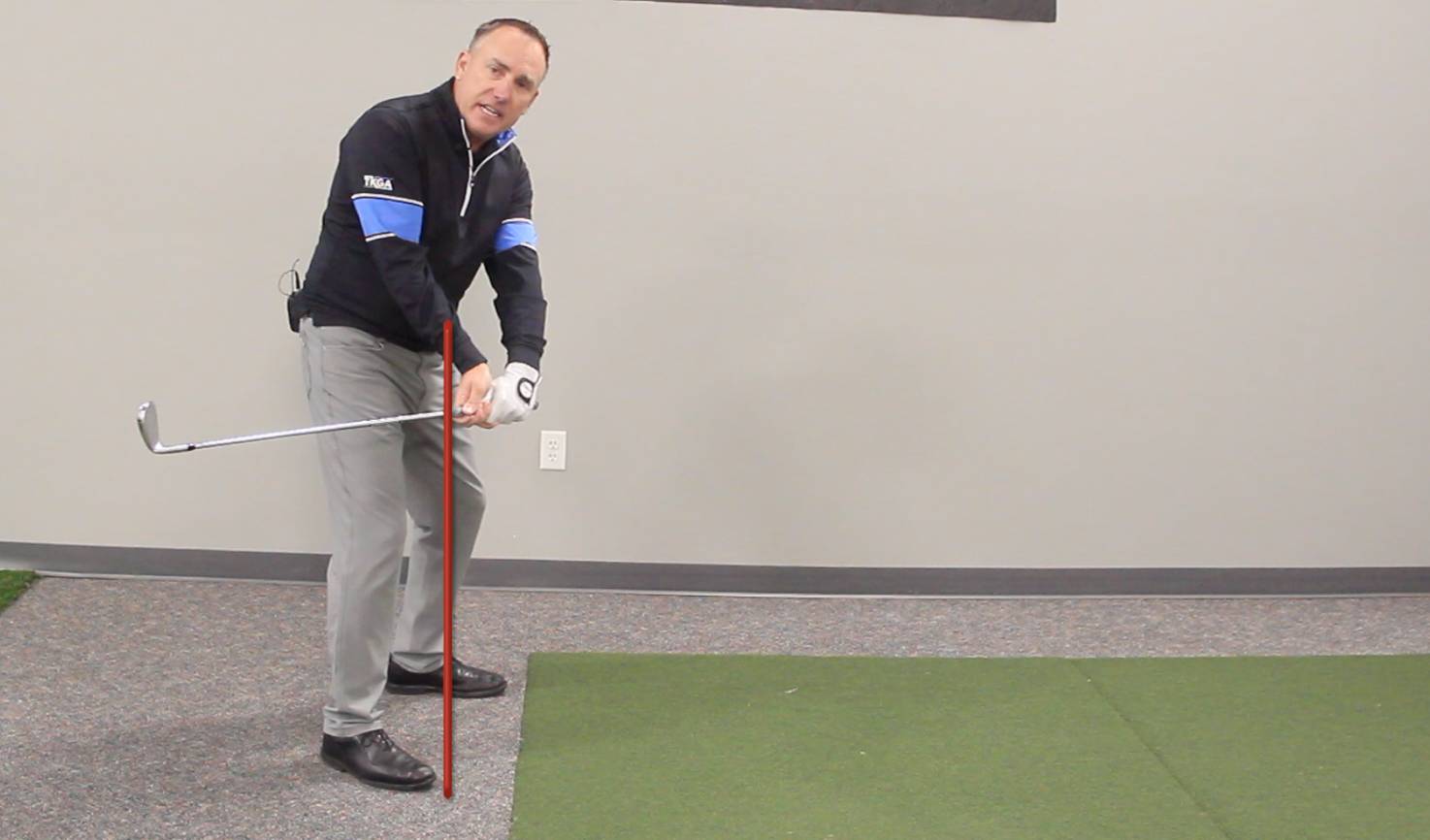
However, if you watch the best players in the world, you’ll notice that there isn’t much consistency when it comes to club direction. Some golfers swing way inside, some swing way outside, and many fall somewhere in between. Meanwhile, they’re all making incredible shots and taking home trophies.
So, here’s a theory: maybe the direction of the club isn’t the real issue.
The Golf Tip: Hand Position
If you watch these same players, you’ll notice there is one thing that remains consistent no matter which direction they guide they club:
They always keep the clubhead outside of the hands.
To clarify, when we talk about keeping the clubhead outside of the hands, we mean the clubhead is just slightly farther out from the body than the hands are. If the clubhead passes through the plane of your hands and closer towards the body, the clubhead is now inside.